
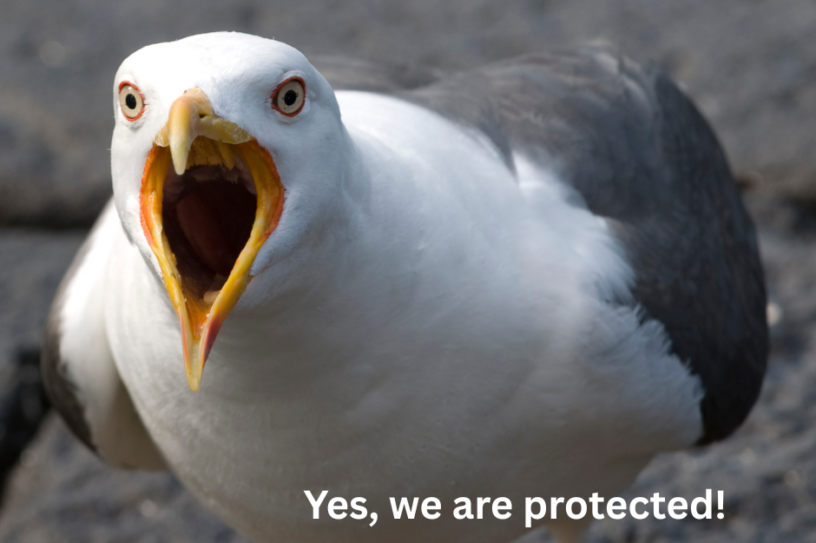
Seagulls….Ugh!
As the spring of 2026 approaches those who like spending time on the water of Michigan will be greeted by our favorite birds…the seagull. They are many times a nuisance, as they flutter around waiting to grab an unsuspecting french fry or chip. But forewarned is forearmed. They are a protected species.
The primary law safeguarding seagulls is the Migratory Bird Treaty Act (MBTA) of 1918. This act was established to protect numerous bird species that migrate across international borders, and all species of gulls fall under this law’s protection. The MBTA makes it unlawful to “pursue, hunt, take, capture, kill, attempt to take, capture, or kill” any protected migratory bird without proper authorization. Penalties under the Migratory Bird Treaty Act are tiered based on the offense and the violator’s intent. Most violations are treated as misdemeanors, which can occur even if the person did not intend to harm the bird. An accidental killing of a seagull, for instance, can still lead to prosecution. The maximum penalty for a misdemeanor conviction is a fine of up to $15,000 and imprisonment for up to six months.
The consequences become more severe if the violation is determined to be a felony. This charge is typically reserved for situations where an individual knowingly harms or kills a migratory bird, particularly with the intent to sell or engage in commercial activity. A felony conviction under the MBTA can result in a fine of up to $250,000 for an individual or $500,000 for an organization, plus a potential prison sentence of up to two years.
Beyond the federal Migratory Bird Treaty Act, individual states have their own wildlife protection laws that often include seagulls. These state-level statutes operate independently of federal law, meaning a person who kills a seagull can face separate charges and penalties from both federal and state authorities for the same act. This creates a situation where total legal jeopardy can be greater than the federal penalties alone.
There are some exceptions to the law. For instance, permits are commonly issued for scientific and educational purposes, allowing researchers and institutions to study bird populations. Another category of exceptions relates to public health and safety. For instance, airports may receive depredation permits to control bird populations that pose a direct threat to aircraft, authorizing the lethal removal of a specified number of birds to mitigate a documented risk.
So, when you think about taking a broom to the nuisance bird, just remember it is better to deter them by keeping food from them, then pay the hefty fine.
About the Author